
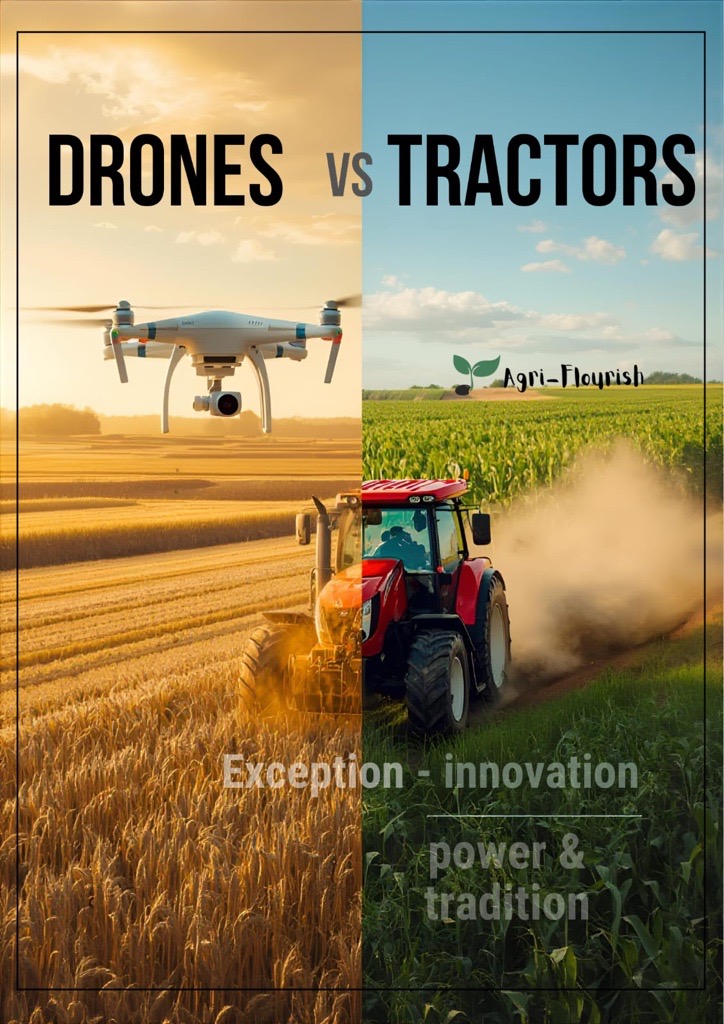
As a young professional working in business development for agricultural drones in South Africa, I’ve had a front‑row seat to one of the most fascinating transitions in modern agriculture. Almost every week, I meet agribusiness owners, dealership teams, and early adopters who are navigating a landscape where tradition and innovation are slowly learning to work side by side.
And here’s what I’ve observed:
Drones in South African agriculture are still in the early stages, but we’re not as early as we used to be.
In just a few years, we’ve gone from curiosity and hesitancy to genuine interest, real investment, and measurable impact. The early adopters have played a crucial role in this shift. These are the farmers who took the risk, tested the technology before it was popular, and proved that it could save time, reduce waste, and improve decision‑making. Their success has laid a foundation that the next wave of farmers is now building upon.
Today, I can confidently say that we are moving, in some places slowly, in others quite dramatically, beyond the early adopter phase. Farmers are no longer asking “What is this drone used for?” but rather, “Where does this fit in my operation?”
This is a profound shift.
The Perception Problem: “Will Drones Replace Tractors?”
With every new technology comes the same concern:
“Is this here to replace what I already know?”
It’s a valid question. For generations, tractors have symbolised reliability, strength, and the physical backbone of farming. So when drones emerged – light, efficient, and increasingly capable – it was natural for farmers to wonder how these two tools compare.
Let me be clear:
Drones are not replacing tractors.
They never will.
Tractors perform mechanical tasks that drones simply cannot do. They break soil, plant seeds, pull implements, carry loads, and handle the heavy, physical work required to run a farm.
Drones weren’t invented to take over that role.
They were created to improve precision, not replace power.
So, What Are Drones Changing?
What drones are doing is reshaping how, when, and how efficiently tractors and other equipment are used.
Drones give farmers:
- Better visibility
- Faster scouting
- More targeted decision‑making
- Precision spraying for specific areas
- Reduced fuel and chemical costs
- Fewer unnecessary tractor passes
- Improved timing during critical stages of the season
In other words…
Drones make tractors smarter.
They make operations leaner.
They turn decisions into data‑driven actions.
When used together, tractors and drones create a more efficient system than either could on their own.
A System, Not a Replacement
Agriculture has always evolved through collaboration between tools, not competition.
The plough didn’t replace the hoe, it scaled the work.
The tractor didn’t replace livestock overnight, it worked alongside them for decades.
GPS didn’t replace farmers, it empowered them.
And now, drones aren’t replacing tractors.
They’re becoming another tool in the system… one that adds intelligence, accuracy, and visibility to the traditional power and reliability of machinery.
The future isn’t about “either/or.”
It’s about integration, timing, and efficiency.
Why This Matters for South Africa
South African farmers face unique pressures:
- Input costs rising
- Climate variability worsening
- Labour shortages
- Profit margins tightening
- Land requiring more precise care
Drones offer practical solutions to these challenges, not theoretical ones.
They help farmers:
- Spray exactly where needed
- Save on chemicals
- Map problems early
- Reduce wasted fuel
- Improve turnaround time
- Respond faster to risks
This is why adoption is growing.
Not because drones are replacing traditional equipment but because they reinforce it.
My Perspective, As Someone Living This Every Day
In my role, I’ve learned that technology adoption in agriculture isn’t about hype. It’s about trust, timing, and fit.
Farmers don’t embrace tools because they’re “new.”
They adopt tools because they work.
And what I’ve seen is that drones work best when they complement – not compete with – traditional machinery.
The early adopters proved this.
The next wave is confirming it.
And the industry is shifting from experiment to strategy.
Final Thought
So, are drones replacing tractors?
No.
But they are reshaping agriculture.
Not by removing the tools farmers rely on, but by strengthening them, supporting them, and making them more efficient.
The real question is not “Which tool is better?”
It’s “How can we use both to build the farms of the future?”
And that’s a conversation I’m excited to keep exploring, this month and beyond
It’s really interesting to see how the agricultural sector in South Africa is evolving, especially with early adopters paving the way for drone technology. Your point about the shift from ‘What is this drone used for?’ to ‘Where does this fit in my operation?’ really captures the growing maturity of the technology. It’s clear that drones are enhancing decision-making and efficiency, but they’re not necessarily replacing tractors—they’re more like complementary tools that help farmers optimize their operations.