How Athenkosi Gwelesha is Building a Future in South African Agriculture
“Agriculture is not just a career, it is a contribution to society’s most basic need: food.”
South Africa’s agricultural sector continues to rely on passionate young professionals who are committed to improving food security, livestock production, and rural livelihoods. In a sector often challenged by climate change, animal diseases, limited resources, and high graduate unemployment, young professionals who remain committed to agriculture are helping shape a brighter future.
Among these emerging leaders is Athenkosi Gwelesha, a dedicated livestock professional whose journey from the rural village of Jixini in the Eastern Cape to the Agricultural Research Council (ARC) demonstrates how passion, resilience, education, and practical experience can transform a dream into a meaningful career.
His story is not simply one of academic achievements or career progression. It is a story of perseverance, continuous learning, and an unwavering desire to improve the lives of farmers and contribute to South Africa’s livestock industry.
Growing Up with Agriculture
Born and raised in Jixini near Mthatha in the Eastern Cape, Athenkosi’s love for agriculture began long before he entered a classroom. Growing up in a rural community where livestock farming formed part of everyday life, he witnessed first-hand how cattle and livestock sustained families, supported household incomes, and contributed to food security. Those experiences left a lasting impression on him.
“My passion for agriculture was inspired by my upbringing in a rural community where farming and livestock played an important role in people’s livelihoods and food security,” he explains. “Growing up, I witnessed first-hand the significant contribution agriculture makes to supporting families and sustaining rural economies.”
Those childhood experiences laid the foundation for a career dedicated to livestock production and agricultural development.
Building a Strong Academic Foundation
Determined to turn his passion into a profession, Athenkosi enrolled at the Fort Cox Agriculture and Forestry Training Institute, where he completed a Diploma in Agriculture specializing in Animal Production.
Recognizing that agriculture is constantly evolving, he continued his studies at the Cape Peninsula University of Technology (CPUT), completing an Advanced Diploma in Agriculture and Livestock Production.
His academic journey equipped him with knowledge in animal breeding, livestock nutrition, herd management, animal health, sustainable production systems, and farm management. However, he quickly realised that agriculture requires much more than classroom knowledge.
“It was through both my studies and practical training that I realized agriculture wasn’t simply a field of study for me, it was a vocation.”
Learning Beyond the Classroom
After completing his diploma, Athenkosi joined Andrew’s Abattoir as an intern, gaining practical experience within an integrated feedlot and abattoir operation. Working in a commercial livestock enterprise exposed him to every stage of production from animal handling and feeding programmes to slaughter processes and meat quality assurance. It was here that theory became reality.
Although permanent employment did not immediately follow, Athenkosi refused to let disappointment define his future. Instead, he invested in further education while continuing to pursue opportunities that would strengthen his experience and expand his skills. His resilience would soon open another door.
Joining One of South Africa’s Leading Agricultural Institutions
In 2026, Atenkosi joined the Agricultural Research Council (ARC) under the Kaonafatso Ya Dikgomo (KYD) Programme, a milestone that marked the beginning of a new chapter in his career. For many agricultural graduates, working at the ARC represents more than employment it is an opportunity to become part of one of South Africa’s most respected agricultural research institutions.
Walking into the ARC for the first time was both exciting and humbling. Surrounded by experienced veterinarians, livestock specialists, extension officers, animal health technicians and researchers, Athenkosi entered an environment where learning never stops.
“The programme provided me with an opportunity to apply the knowledge and skills I acquired during my studies while continuing to learn from experienced professionals in the field,” he says.
Working alongside these experts gave him a new appreciation for scientific research, animal health management, and agricultural extension. Every discussion, farm visit, and technical meeting became a learning opportunity. He observed how experienced professionals approached disease outbreaks, herd improvement, data collection, and farmer support using both science and practical experience.
He soon realised that the success of South African agriculture depends on collaboration between researchers, extension officers, veterinarians, and farmers.
Making a Difference Through the KYD Programme
As an ARC intern, Atenkosi’s responsibilities extended far beyond office work. His work involved recruiting farmers into the Kaonafatso Ya Dikgomo Beef Recording Scheme, conducting livestock recording, collecting herd performance data, assisting with farm assessments, supporting herd improvement initiatives, training farmers, and maintaining livestock databases. Regular visits to farming communities allowed him to witness both the challenges and opportunities facing emerging livestock farmers.
“Livestock recording enables farmers to identify high-performing animals, make informed breeding decisions and improve productivity over time,” he explains. He believes accurate livestock recording is one of the most powerful tools available to farmers because it improves breeding decisions, increases productivity, strengthens herd genetics, and ultimately improves profitability.
Learning from South Africa’s Agricultural Experts
Perhaps one of the greatest benefits of working at the ARC has been learning directly from professionals with years of experience in research and livestock development. Whether accompanying veterinarians during disease investigations, observing extension officers working with farmers, or discussing livestock performance with specialists, Athenkosi developed technical knowledge that cannot be gained from textbooks alone.
He learned that successful agricultural professionals never stop asking questions, never stop learning, and never stop adapting. Working alongside multidisciplinary teams also strengthened his confidence, communication skills, leadership ability, and understanding of teamwork.
Working with Farming Communities
One of the most rewarding aspects of his work has been interacting directly with smallholders and emerging farmers.These experiences taught him that every farming community possesses valuable indigenous knowledge developed over generations. Rather than replacing that knowledge, agricultural professionals should work alongside farmers to combine practical experience with scientific innovation. Building trust required patience, respect, and consistency.
Through regular farm visits and open communication, he was able to support farmers in improving record keeping, livestock management, breeding practices, and animal health.
“I learned that farming communities possess a wealth of indigenous knowledge and practical experience that can complement scientific approaches.”
A Defining Career Moment
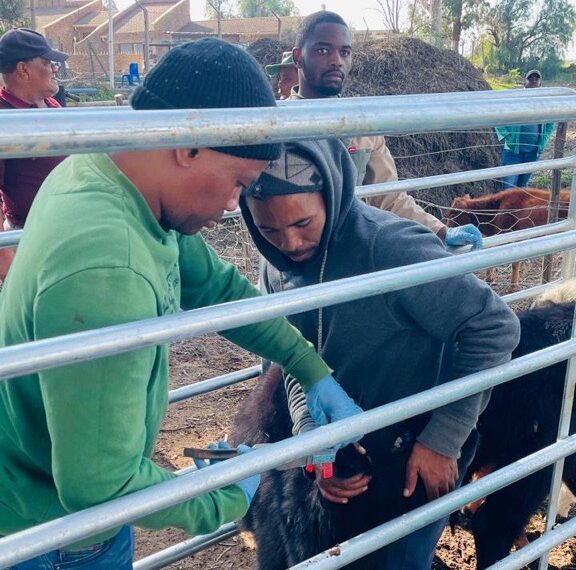
Among all his experiences at the ARC, participating in the Foot-and-Mouth Disease (FMD) Vaccination Campaign stands out as one of the most significant. Working alongside veterinarians, animal health technicians, extension officers, and fellow interns, Athenkosi assisted with animal handling, vaccination activities, data recording, and farmer awareness programmes.
The campaign gave him first-hand exposure to disease prevention on a large scale while highlighting the importance of teamwork and collaboration in protecting South Africa’s livestock industry.
“This experience reinforced my passion for livestock production and animal health while highlighting the importance of teamwork in managing livestock diseases.” For Atenkosi, protecting livestock means protecting food security, rural livelihoods, and the country’s agricultural economy.
A Message to Young Agricultural Professionals
Athenkosi encourages young graduates not to wait for perfect opportunities. Instead, he believes they should volunteer, complete internships, attend agricultural events, network with professionals, and seek practical experience wherever possible.
“Agriculture is not just a career , it is a contribution to society’s most basic need: food.”
His message is simple: education opens the door, but practical experience and perseverance build a successful career.
Editor’s Reflection
At Agri-Flourish, we believe agriculture flourishes when passionate young professionals are empowered to learn, innovate, and serve.
Atenkosi Gwelesha’s journey reminds us that the future of South African agriculture depends not only on technology and research but also on dedicated individuals willing to work alongside farming communities, share knowledge, and continuously grow.
From the communal grazing lands of Jixini to the laboratories, offices, and farms connected through the Agricultural Research Council, his journey is a testament to what determination, education, and service can achieve.
His story is more than an individual success it is an inspiration to every young South African who dreams of making a meaningful contribution to agriculture. At Agri-Flourish, we celebrate professionals like Atenkosi because they are helping ensure that South African agriculture continues to flourish for generations to come.