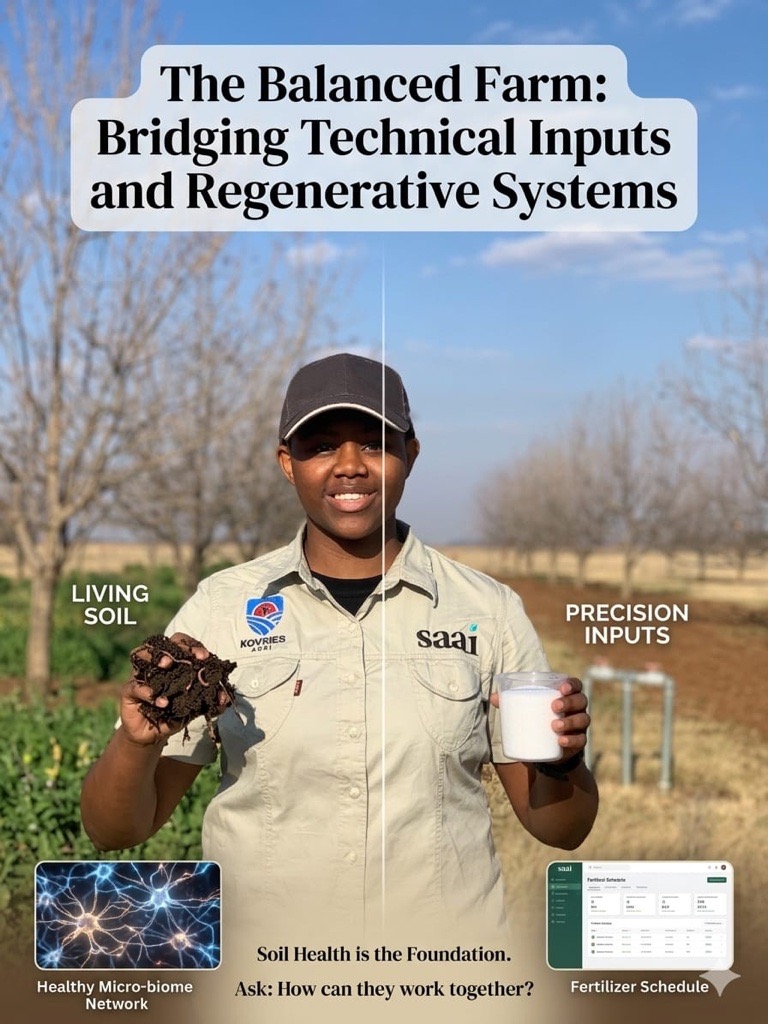
We know how to calculate fertilizer down to the kilogram. We know exactly when to spray. We know how to push yield.
But ask a simple question.
What is feeding the soil?
That is where things get quiet.
This is not about discrediting agricultural education. It is about recognising a gap that is becoming harder to ignore.
Many graduates leave university equipped with strong technical knowledge. They understand input planning, fertilizer calculations, and crop protection strategies.
And those skills matter. But they are not complete.
Agriculture is not just about managing crops. It is about managing a living system.
Soil is alive. It is made up of microbes, fungi, bacteria, and organic matter that work together to cycle nutrients, retain water, and support plant growth.
Yet in many cases, soil is still treated as a medium. Something to add inputs into, rather than something to build.
We talk about crop rotation. We mention sustainability. But rarely do we go further.
What happens to soil biology when land is left bare? What are microbes actually feeding on? How do we maintain activity between planting cycles?
Fallow periods are still normalised. Clean fields are still praised.
But bare soil is not neutral.
It is exposed to erosion, moisture loss, and biological decline. Over time, that has consequences.
Regenerative agriculture shifts the focus
Not away from production, but deeper into what supports it.
It asks how we keep roots active in the soil, how we feed microbial life, and how we build structure instead of constantly correcting problems.
Practices like cover cropping, maintaining soil cover, and increasing biodiversity are not extras. They are essential to long term soil function.
Because without biological support, inputs carry more and more of the system.
Where the disconnect becomes clear
We are producing graduates who understand how to apply nutrients, correct deficiencies, and manage crops efficiently.
But fewer are trained to interpret soil health beyond lab results, understand biological processes, and integrate regenerative practices into real farming systems.
This is not about choosing sides.
Synthetic fertilizers are effective tools. Crop protection products are important. Input planning is necessary. But when these become the main strategy, rather than part of a broader system, dependency increases.
Regenerative thinking does not reject inputs. It strengthens the system so inputs are used more effectively.
If agriculture is evolving, education has to evolve with it
There is a growing need for deeper soil focused learning, regenerative agriculture integration, and systems based thinking.
Industry training through organisations like CropLife South Africa and FERTASA plays an important role in building technical understanding of inputs and nutrient management. But the real value comes from connecting that knowledge to soil health.
Knowing what to apply is one thing. Understanding how the system responds is another.
What this means for you
If you are studying agriculture or entering the industry, this matters. The industry you are stepping into is changing.
Soil health is directly linked to productivity, cost, and long term sustainability.
The professionals who will stand out are not just those who follow programs. They are the ones who understand systems.
Do not wait for the curriculum to catch up. Start asking how to keep soil biologically active and how regenerative practices fit into what you already know.
Because the knowledge you build now will shape how you farm, advise, or manage in the future.
Final thought
We are not lacking knowledge in agriculture. We are lacking balance in what we prioritise.
The future of farming will not be defined by how precisely we apply inputs.
It will be defined by whether the soil can continue functioning without needing more of them every season.