Global wars often feel far away until they begin to show up in the numbers that matter most. For South African agriculture, that moment may already be here.
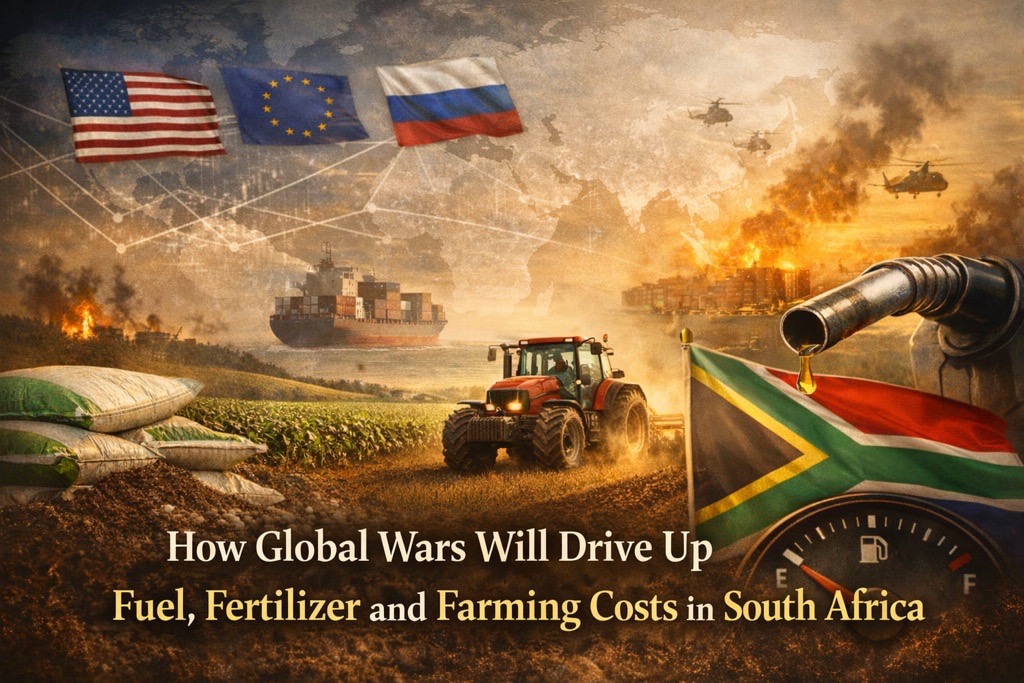
From where I stand, the real danger is not only what is happening on the battlefields. It is what those wars are doing to fuel markets, shipping routes, fertilizer supply chains and, ultimately, the cost of producing food in South Africa. When conflict disrupts major trade corridors and energy routes, farming does not escape the fallout. It absorbs it.
How global conflict reaches South African farms
South Africa has already seen fuel price pressure. That matters because diesel is not just another cost on a farm. It powers tractors, harvesters, irrigation systems, generators and transport. When diesel rises, it pushes up the cost of nearly everything from land preparation to getting produce to market.
And fuel is only the start.
Conflict in critical shipping zones is adding a second layer of pressure. When major trade routes become unstable, insurance costs rise, shipping slows, rerouting becomes expensive and global input prices become more vulnerable.
That is where South African agriculture becomes especially exposed. We are not insulated from global price shocks. We import fuel-linked products, we rely on international shipping, and many farming inputs are priced in a global market. Even when commodity prices calm down in one area, supply chain stress can still keep essential inputs expensive.
Why fuel prices matter more than most people realise
Fuel costs do not sit in one corner of the farm budget. They move through nearly every operation, including:
● Land preparation and planting
● Fertilizer and chemical applications
● Irrigation and pumping
● Harvesting and field operations
● Cold chain and storage support
● Transport to packhouses, feedlots, processors and markets
Once diesel rises, those higher costs ripple through the whole chain. The farmer pays more first, but eventually the entire food system feels it.
Fertilizer could become one of the biggest pressure points
For farmers, fertilizer is one of the most sensitive pressure points of all.
In grain production, fertilizer can already account for a major share of seasonal input costs. Those are not small numbers. Any further increase in fertilizer pricing, freight or exchange-rate pressure can immediately tighten margins.
The real concern is that fertilizer is linked to global energy, manufacturing and shipping systems. If those systems come under pressure, South African producers may end up paying more at exactly the time when margins are already under strain
The knock-on effect accross crop and animal production
This does not affect crop farmers only. It runs across the agricultural value chain.
Crop production
● Land preparation becomes more expensive
● Fertilizer programmes cost more
● Spraying and irrigation costs rise
● Harvesting and transport margins tighten
Animal production
● Feed costs rise when crop input costs rise
● Transport of animals and feed becomes more expensive
● Power, cooling and daily operating costs increase
● Pressure eventually reaches meat, milk and egg prices
Feed production depends on grain, grain production depends on fertilizer and diesel, and livestock operations themselves rely on fuel for transport, cooling, backup power and daily logistics. When crop input costs rise, feed costs can rise. When fuel rises, distribution costs rise.
Other factors likely to increase production costs
The pressure on agriculture is not coming from one source alone. A number of connected factors can lift production costs at the same time:
● Rising diesel and petrol prices
● Higher fertilizer costs
● Increased shipping and freight costs
● Exchange-rate pressure on imported inputs
● More expensive feed inputs
● Transport and distribution costs
● Irrigation and power-related operating costs
● Infrastructure and logistics constraints
The broader concern is that farming becomes more expensive at every stage, while profitability becomes harder to protect. Farmers are then forced into difficult decisions. Do they cut fertilizer
rates? Delay maintenance? Reduce planting area? Pay more for transport? Absorb losses to keep markets supplied? None of these are good options, and all of them carry risk for food production and long-term resilience.
Why biological products deserve serious attention now
This is why I believe the current moment should push the industry to think differently about inputs, especially soil fertility and crop nutrition.
For years, many producers have leaned heavily on synthetic inputs because they are familiar, predictable and widely available. But the world is changing. Supply chains are more fragile. Energy markets are more political. Shipping is more vulnerable. That means the old assumption that conventional inputs will always be available at workable prices is no longer safe.That is where biological products deserve serious attention.
I am not suggesting that every conventional input can disappear overnight, or that every biological product is a one-size-fits-all solution. But the bigger direction is clear: healthier soils, smarter nutrient management and reduced dependency on volatile input systems can help build resilience.
Why they deserve more serious attention:
● They can support soil health
● They may improve nutrient efficiency
● They can reduce dependency on volatile external inputs
● They support longer-term sustainability
● In some systems, they may lower costs over time
Biological products, organic inputs and regenerative approaches deserve more than a passing mention in this conversation. They offer a way to rebuild soil biology, improve nutrient efficiency and reduce the pressure to rely entirely on costly external inputs. In other words, the future is not simply about replacing one bag with another. It is about building a system that is less exposed when global shocks hit.
That matters in South Africa because farming here is already dealing with enough uncertainty. Weather risk. Input volatility. Infrastructure problems. Power-related costs. Freight constraints. Currency pressure. Add prolonged global conflict to that list, and the case for resilient farming systems becomes even stronger.
Conclusion
My view is simple: this is the time to start using biological products where they make practical sense, or to continue using them if you already have. Not because it sounds fashionable, but because the economics of dependence are becoming more dangerous. The more exposed a farm is to imported, energy-intensive and globally disrupted inputs, the more vulnerable that business becomes when another geopolitical shock lands.
The farmers and agribusinesses that will cope best in the years ahead may not be the ones chasing the highest short-term response from the most expensive inputs. They may be the ones
who have invested in soil health, nutrient efficiency, biological support systems and production strategies that can still hold together when the world outside the farm gate becomes unstable.
Wars abroad do not stay abroad forever. Eventually, they arrive in diesel tanks, fertilizer invoices, feed bills and food prices.
And when they do, South African agriculture will either pay the price of dependence, or benefit from the choices it made early enough to adapt.