
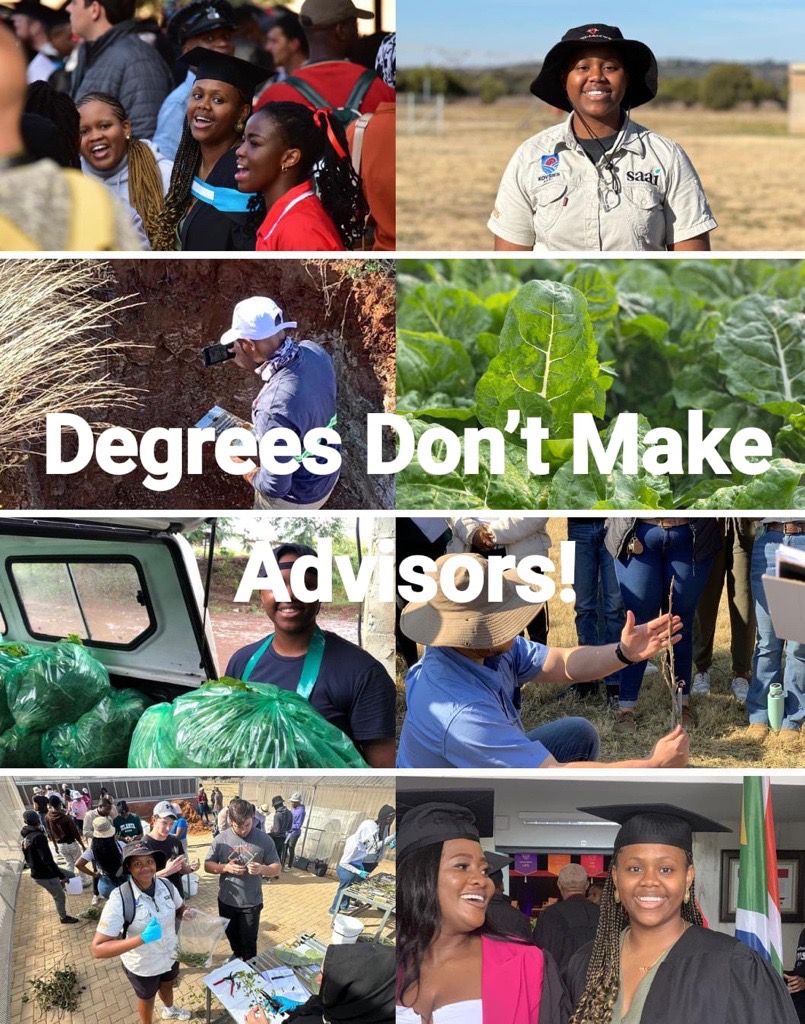
Let’s be honest about something the agricultural industry rarely says out loud:
A degree does not make you an advisor. It makes you a graduate with potential, not authority.
And in agriculture, potential means very little until it is backed by field experience.
This is where many graduates are misled. Not intentionally, but systematically. The idea is sold that once you complete your studies, you will transition smoothly into advisory roles, technical positions, or well-paying agricultural jobs.
That is not how the system works.
In reality, agriculture does not promote based on qualifications alone. It promotes based on trust, exposure, and proven field performance.
The illusion of the straight path into agriculture
Students are often led to believe there is a clear pipeline:
Study > Graduate > Get a job > Become an advisor
But the agricultural industry operates on a completely different logic:
Study > Prove yourself repeatedly > Start at the bottom > Stay there longer than expected > Then maybe progress
This is not pessimism. It is structure. And it is the part most graduates only understand once they are already inside the system.
The hard truth: you are not ready to advise after graduation
This is where many people get uncomfortable, but it needs to be said clearly:
A graduate fresh out of university is not ready to give agricultural advice to farmers in real conditions.
Not because they are unintelligent. Not because they lack potential. But because agriculture is not theoretical. It is consequence-driven.
A wrong recommendation in agriculture is not just a mistake on paper. It affects:
- Yield
- Income
- Soil health
- Entire farming seasons
And that level of responsibility is not earned through lectures. It is earned through exposure.
The reality nobody advertises: you start at the bottom
Most agriculture graduates do not begin their careers as advisors. They begin as:
- Interns
- Assistants
- General farm workers
- Technical support staff
And yes, many enter the industry on low stipends, sometimes around R5,000 or less, often without transport or accommodation support.
This is where the contradiction begins: you are qualified, but still financially and professionally starting from zero.
The uncomfortable career ladder in agriculture
Agriculture does not reward speed. It rewards survival. The real progression looks like this:
- Degree or diploma
- Entry-level farm or internship role
- Years of field exposure
- Repeated seasonal learning cycles
- Slowly gaining technical responsibility
- Only then transitioning into advisory influence
There is no shortcut that replaces this process. And anyone telling students otherwise is selling an incomplete version of reality.
The myth of guaranteed employment after internships
Another uncomfortable truth is that internships are not job guarantees. Even after long programmes, sometimes 12 to 24 months, employment is still uncertain.
In many structured environments, only a small fraction of interns are absorbed into permanent positions afterward. This is not always about performance. It is often about:
- Limited vacancies
- Budget constraints
- Organisational restructuring
- Timing and opportunity availability
Which means: you can do everything right and still not be hired. That is the part nobody prepares graduates for.
Why agriculture works this way
Agriculture is not structured like corporate graduate programmes. It is built on:
- Seasonality
- Risk
- Experience-based decision-making
- Financial constraints at farm level
- High responsibility with low margin for error
This creates an industry where trust matters more than certificates. Before a farmer trusts your recommendation, they need proof you understand reality, not just theory.
Professional gatekeeping and the system students don’t see
In many technical and advisory roles, credibility is also tied to professional accountability systems such as SACNASP. This adds another layer to the career path:
- Qualification alone is not enough
- Experience is required
- Professional registration may be required
- Only then is full advisory responsibility recognised
Yet most students only discover this after graduating, not during their studies.
The truth about “luck” in agriculture
Yes, some graduates do move quickly. Some get absorbed early. Some find opportunities faster than others. But the majority do not.
Most agricultural careers are not shaped by luck. They are shaped by:
- Availability of positions
- Timing
- Mentorship access
- Long-term persistence in low-level roles
Which means progress is not equal, and it is not predictable.
What students need to stop believing
If you are studying agriculture, here are hard truths you need early:
- Your degree does not qualify you to advise immediately
- Your first job will likely not match your expectations
- Experience matters more than academic performance in the field
- Employment after internships is not guaranteed
- Career growth is slow and uneven
This is not negativity. It is preparation.
Final truth: agriculture does not reward titles. It rewards time.
Becoming an agricultural advisor is not about how fast you graduate. It is about how long you stay in the system long enough to understand it properly.
Because in agriculture, credibility is not claimed. It is earned in the field, over seasons, through mistakes, correction, and repetition.
And until that happens, a degree is just a starting point, not a position of authority.

A very insightful and thought-provoking article. It highlights an important reality in South Africa’s agricultural sector that is often overlooked.